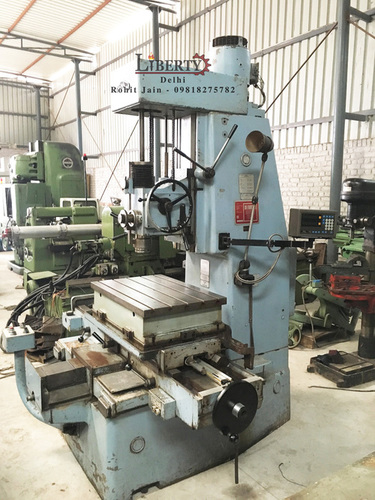
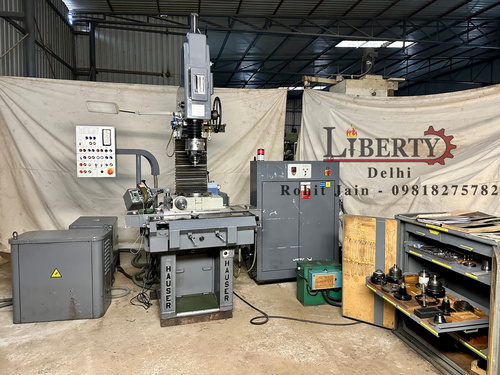
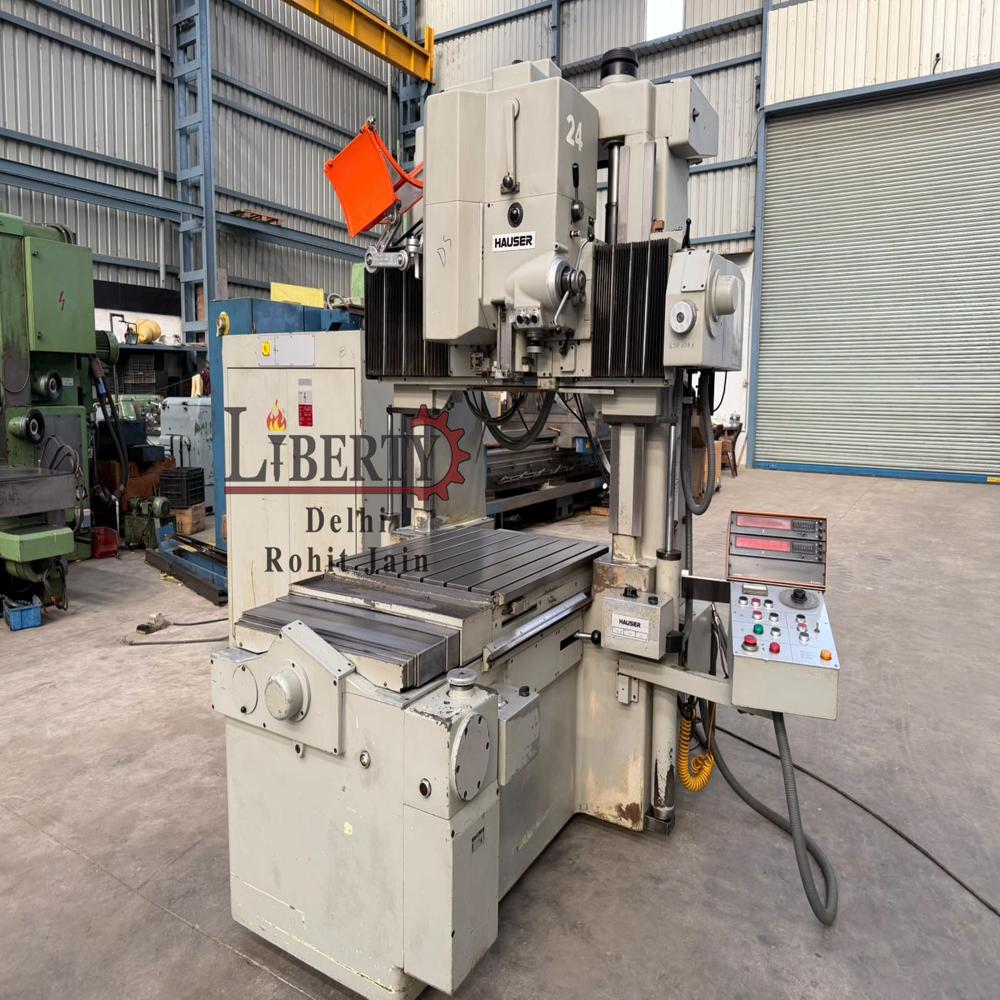
About Hauser Switzerland Jig Boring Machine
Make - Hauser (Switzerland)
Table Size - 705 mm x 510 mm
Longitudinal Travel of Table - 625 mm
Cross Travel of the Boring-Head - 415 mm
Spindle Speeds - 50 rpm to 1500 rpm
Spindle Feed Travel - 160 mm
Spindle Feed Rates - 0.03 / 0.08 / 0.13 mm/rev
Spindle Taper - MT 3
Spindle Diameter - 65 mm
Distance between Columns - 700 mm
Max. Height between Table to Spindle - 660 mm
- Equipped with DRO on Longitudinal, Cross & Vertical Travels.
- Machine is in excellent working condition.
Video of The Machine -
https://youtu.be/7FHa_-4DqvA
Engineered for Ultimate PrecisionBuilt to Class 1 ISO standards, the machine delivers unrivaled accuracy for bore and hole alignment. The high-precision feed system, sturdy cast iron construction, and rigid structure enable consistent results even in demanding engineering environments. Its manual clamping system with T-slots ensures optimal workpiece stability during operations.
Versatile and User-Friendly FeaturesDesigned for diverse precision boring tasks, the Hauser Jig Boring Machine features a spacious worktable and extensive axis travel (850/650/500 mm), maximizing both flexibility and capacity. Equipped with a 3-axis digital readout, operators can easily monitor positioning and achieve meticulous bore depth control, supporting advanced tool room projects.
Efficient Maintenance and OperationMaintenance is simplified through centralized automatic lubrication and an integrated coolant pump, maintaining both the machine and the workpiece. The low operating noise (<75 dB) and effective cooling system promote comfortable, continuous use. Its easy-to-use controls and reliable power source (400 V, 5.5 kW) streamline daily workshop operations.
FAQ's of Hauser Switzerland Jig Boring Machine:
Q: How does the Hauser Jig Boring Machine achieve superior accuracy in drilling and boring operations?
A: The machine utilizes a high-precision feed mechanism, robust cast iron construction, and is built to Class 1 ISO standards. Combined with a 3-axis digital readout, these features enable precise control and alignment of bores and holes, resulting in outstanding accuracy in all operations.
Q: What types of jobs or materials can be processed on this machine?
A: This jig boring machine is ideal for precision boring tasks in engineering workshops, tool rooms, and manufacturing units. It can handle a variety of materials, including metals and alloys, and has a minimum boring diameter of 1 mm and maximum of 300 mm, allowing for versatility across components and hole sizes.
Q: When is the Hauser Jig Boring Machine most beneficial to use in a workshop?
A: The machine is most beneficial when exceptionally precise bore alignment and diameter control are required, such as in toolmaking, mold production, and high-tolerance engineering parts. Its Class 1 precision makes it suitable for tasks where accuracy cannot be compromised.
Q: Where is this machine commonly installed or used?
A: It is commonly installed in engineering workshops, tool rooms, and manufacturing facilities that require high-precision boring capabilities. The machine's robust design and table capacity (up to 800 kg) make it suitable for both medium and heavy machining environments.
Q: What is the process for maintaining the Hauser Jig Boring Machine?
A: Maintenance involves routine cleaning, monitoring lubrication levels via its centralized automatic system, checking the integrated coolant pump, and inspecting manual clamping and DRO functions. Regular maintenance ensures longevity, reliability, and consistent performance.
Q: How is the clamping and table adjustment carried out during operation?
A: Workpieces are secured manually using the provided T-slots on the large worktable, ensuring firm clamping and stability. Table movements across X, Y, and Z axes are controlled via user-friendly handles and monitored accurately on the digital readout system.
Q: What advantages does the integrated coolant and lubrication system offer?
A: The integrated coolant pump and centralized automatic lubrication system protect the machine and workpiece, reduce friction and heat, and minimize wear. These features help prolong the machine's lifespan and maintain high operating precision.







 Send Inquiry

 Send Inquiry
 Send Inquiry
 Send SMS


