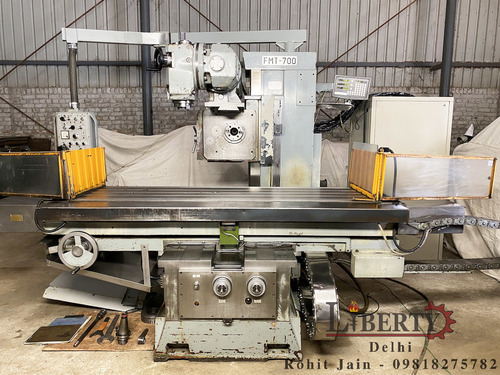
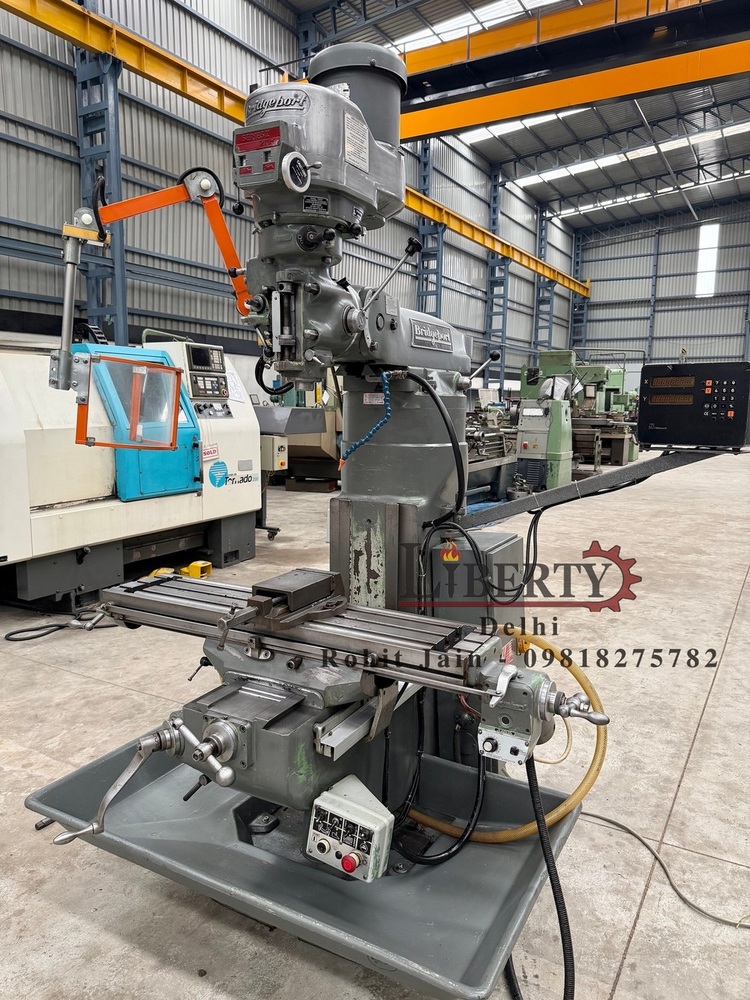
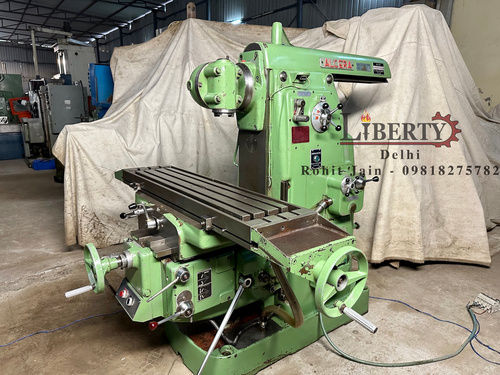
About CME Spain FU-2 Universal Milling Machine
Make - CME (Spain)
Model - FU-2
Table Size - 1400 mm x 300 mm
XYZ Travels - 1100 mm x 300 mm x 500 mm
Spindle Taper - ISO 40
Spindle Speeds - 40 rpm to 1800 rpm
Table Feed Rate of Travel - 12.5 mm/min to 1030 mm/min
- Equipped with a 3-Axis DRO.
- Parking type Double-Swivel type Universal Milling Head.
- With Arbour and Bracket for Horizontal Milling Operations.
- Rotating type Universal Table.
- Machine is in excellent working condition.
Video of The Machine -
https://youtu.be/9m8EZWxOSkA
Precision Meets VersatilityThe CME FU-2 Universal Milling Machine is designed to handle a broad spectrum of precision milling demands. Its horizontal and vertical milling capabilities, coupled with a universal swivel table, enable users to complete complex machining processes efficiently. The robust construction and advanced spindle bearings ensure excellent stability, making it a trusted choice for demanding engineering applications.
Engineered for Heavy-Duty PerformanceWith a powerful 4 kW main motor and a solid table supporting up to 500 kg, the FU-2 is tailored for heavy-duty workloads. The precision ground box-type table slide ways deliver accurate movements, while the extensive longitudinal (1000 mm), cross (360 mm), and vertical (410 mm) travels facilitate machining of large components with ease.
User-Friendly and ReliableOperating the FU-2 is straightforward, thanks to its manual control system and easy-to-adjust feed rates. The rapid traverse feature (1800 mm/min) boosts productivity by minimizing idle time between machining operations. Durable materials and quality manufacturing from Spain ensure reliability and longevity.
FAQ's of CME Spain FU-2 Universal Milling Machine:
Q: How do I operate the CME FU-2 Milling Machine for different milling tasks?
A: The FU-2 operates manually, allowing users to set feed rates, table movements, and spindle speeds according to the specific task. For horizontal milling, use the horizontal spindle; for vertical operations, switch to the vertical head. Adjust the table's swivel position for angular cuts. Always follow safety protocols and refer to the user manual for setup instructions.
Q: What materials can the CME FU-2 efficiently machine?
A: This milling machine is built to handle a range of materials such as cast iron and steel. Its heavy-duty construction and precision bearings make it suitable for machining both hard and soft metals used in engineering and fabrication projects.
Q: When is the FU-2 model recommended over other milling machines?
A: The FU-2 is best suited when your operations require high precision, flexible table adjustment (swiveling 45), and the ability to mill large or heavy parts. It is ideal for tool rooms, repair shops, and manufacturing units where both vertical and horizontal milling are frequently required.
Q: Where can the CME FU-2 Universal Milling Machine be installed, considering its size and floor space requirements?
A: With dimensions of 2350 x 2000 x 1800 mm, the FU-2 requires a spacious workshop environment. Ensure the installation area is level, has sufficient overhead clearance, and meets the 415 V power supply specification for optimal operation and safety.
Q: What is the process for adjusting spindle speed and feed rates on this milling machine?
A: Spindle speeds (40 - 1,600 rpm) are adjusted using the machine's control levers to select from 18 available speed steps. Feed rates for longitudinal and cross axes range from 20 - 400 mm/min, and rapid traverse can be engaged at 1800 mm/min for swift repositioning of the table.
Q: How does the universal swivel table benefit complex machining applications?
A: The universal swivel table (45) allows workpieces to be rotated and precisely angled, accommodating intricate milling and angular tasks without repositioning the part. This capability is essential for multi-face machining and complex part geometries.
Q: What are the maintenance requirements to ensure longevity and performance of the FU-2?
A: Regular maintenance includes lubricating moving parts, checking spindle bearings, cleaning slide ways, and inspecting the coolant pump. Periodic checks should be performed to ensure all manual controls and safety devices are functioning correctly, in accordance with the manufacturer's guidelines.








 Send Inquiry

 Send Inquiry
 Send Inquiry
 Send SMS


