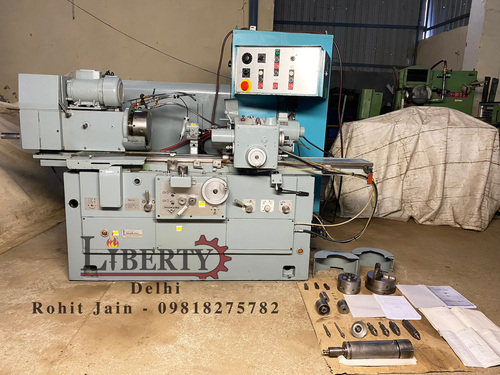
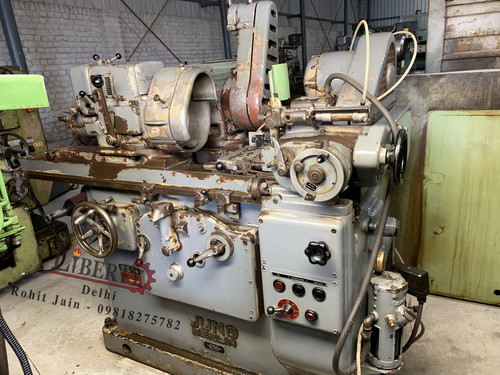
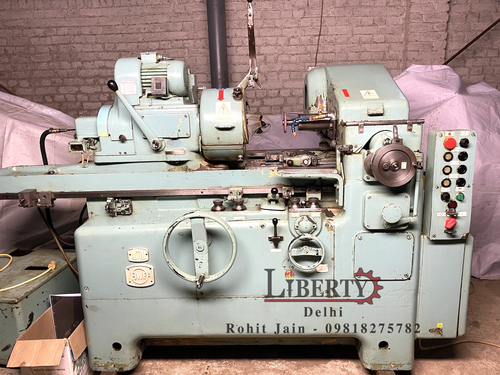
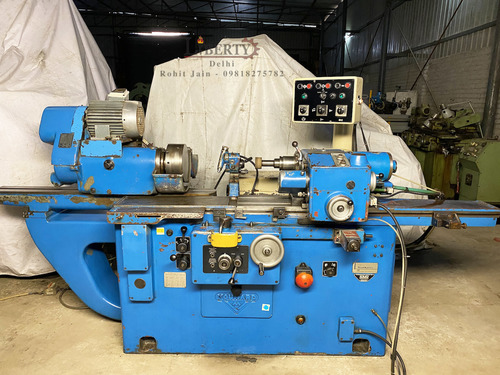
About Voumard Type 5 Internal Grinding Machine
Make - Voumard (Switzerland)
Model - Type 5
Grinding Diameter Range - 5 mm to 200 mm
Center Height - 180 mm
Max. Swing Diameter of Job - 360 mm
Maximum Table Stroke - 600 mm
Max. Spindle Speed - 28,000 rpm
Work-Head Speeds - 50 rpm to 600 rpm (Continuously Variable)
Work-Head Swivel Angle - 0 to 90
- Features like Hydraulic Wheel-Dresser, Auto-Cut etc.
- 2 x Grinding Spindles available - of 15,000 rpm and of 28,000 rpm.
- Complete with accessories like spare chucks, pulleys, quills etc.
- Operating Manual & Electrical Drawings are available.
- Machine is in excellent working condition.
Video of The Machine -
https://youtu.be/2TPsl907BhY
Robust Precision EngineeringDesigned in Switzerland, the Voumard Type 5 is renowned for its rugged build and precise grinding capabilities. Its three-jaw chuck attachment ensures secure workpiece holding, while the sturdy cast iron structure minimizes vibrations for higher accuracy. The V-Flat table slide way allows for consistent movement and exceptional surface finishes.
Efficient Manual Operation and VersatilityOperational via manual controls, the Voumard Type 5 gives experienced machinists the flexibility to adjust wheel head movement and parameters as needed. With integrated recirculating coolant and centralized automatic lubrication, its engineered for longer uninterrupted use. Its flexibility makes it a trusted choice in both production and bespoke precision grinding tasks.
High-Quality Surface FinishingThe machine achieves surface finishes as fine as 0.3 m Ra, thanks to high rotational spindle speeds (up to 27,000 RPM) and comprehensive accessories. Mandrels, diamond dressers, and wheel flanges are included as standard, supporting a range of internal cylindrical grinding applications for critical engineering components.
FAQs of Voumard Type 5 Internal Grinding Machine:
Q: How does the Voumard Type 5 ensure high-precision internal grinding?
A: The Voumard Type 5 achieves high precision through its robust cast iron construction, V-Flat table slide way, and accurate three-jaw chuck attachment. The manually adjustable wheel head and high spindle speeds (up to 27,000 RPM) contribute to its ability to achieve surface finishes as low as 0.3 m Ra.
Q: What are the typical applications and components suitable for this grinding machine?
A: This machine is ideal for internal cylindrical grinding of precision components made from materials like cast iron and steel. Common applications include the manufacturing of bearing races, bushings, and other round components requiring tight tolerances and smooth surface finishes.
Q: When should the machines lubrication system be checked or maintained?
A: The centralized automatic lubrication system is designed to maintain itself during regular operation. However, periodic checks according to the manufacturers recommendations should be done to ensure the reservoir is filled and system parts are functioning properly.
Q: Where can this machine be installed for optimal results?
A: It is best installed in a stable, vibration-free workshop environment. The required floor space is 1600 mm by 2000 mm. The machine should be positioned on a solid floor to support its weight (1800 kg) and ensure consistent precision.
Q: What is the standard process for setting up a workpiece in the Voumard Type 5?
A: Begin by securing the workpiece using the three-jaw chuck on the T-slot table. Adjust the wheel head position manually to align with the work area. Attach the required mandrel and use the diamond dresser to prepare the grinding wheel. Activate the coolant system and begin grinding according to specific component requirements.
Q: How does the integrated coolant system benefit the grinding operation?
A: The integrated recirculating coolant system minimizes heat build-up and removes grinding debris, helping maintain workpiece dimensional accuracy and prolonging the lifespan of grinding wheels.
Q: What advantages does manual control offer versus computerized models?
A: Manual control provides skilled operators with the flexibility to make on-the-fly adjustments and handle unique or custom jobs. This is beneficial in specialized production environments where adaptability and operator versatility are critical.








 Send Inquiry

 Send Inquiry
 Send Inquiry
 Send SMS


