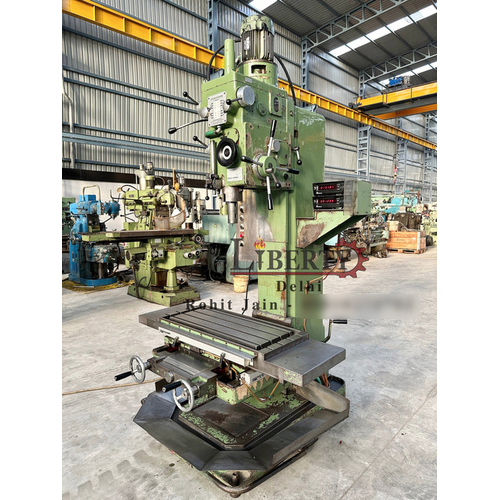
About Rochelet Lavergne Vertical Drilling & Milling Machine
Make - Rochelet Lavergne (France)
Capacity - 40 mm
Table Size - 900 mm x 380 mm
X-Y Table Travels - 575 mm x 280 mm
Spindle Diameter - 90 mm
Spindle Taper - MT 4
Spindle Speeds - 40 rpm to 1600 rpm
Spindle Travel - 260 mm
Spindle Feed Rate of Travel - 0.05 mm/rev to 0.30 mm/rev
Max. Height between Spindle to Table Top - 880 mm
Distance between Spindle Center to Vertical Column - 350 mm
- Equipped with 2-Axis DRO.
- Equipped with Foot Operated Spindle Brake.
- Complete with Coolant Tank & Pump.
- Machine is in excellent working condition.
Video of The Machine -
https://youtu.be/6rnDtKaJRoY
Designed for Heavy-Duty MetalworkingThis vertical drill-mill combination is engineered for precision and durability in metal component processing. Its low-noise operation, sturdy cast iron and steel build, and robust table accommodate demanding applications such as drilling, milling, boring, and tapping, making it indispensable for workshops and machine shops tackling varied metal fabrication needs.
Versatile Adjustments and ControlsOperators benefit from an adjustable spindle head, hand lever controls, and a 6-step spindle speed range (80-1800 RPM), allowing precise adaptation for different materials and tasks. The machine's substantial quill travel, cross, and longitudinal table movement enable effective handling of large workpieces or complex operations with efficiency.
Reliable and User-Friendly OperationWith its straightforward manual controls, dependable MT3/ISO 40 spindle, and inbuilt coolant system, this used machine remains dependable for daily use. The ergonomic layout and accessible features ensure safety and ease of use, even for extended periods, supporting high productivity in both small-scale and industrial workshops.
FAQ's of Rochelet Lavergne Vertical Drilling & Milling Machine:
Q: How does the Rochelet Lavergne Vertical Drilling & Milling Machine support different metalworking applications?
A: The machine features heavy-duty construction, a variable speed spindle (6 steps from 80 to 1800 RPM), and precision controls, enabling it to perform a wide range of operations such as drilling, milling, boring, and tapping on varied metal components with accuracy and reliability.
Q: What materials can the machine process and what is its maximum drilling capacity?
A: Designed for machining cast iron and steel, the machine can drill through metals up to 32 mm in diameter, making it suitable for various industrial and fabrication environments requiring robust, high-capacity drilling and milling.
Q: When is this machine most beneficial to use in a workshop?
A: This vertical combination drill and mill is particularly advantageous when versatile, high-precision operations are needed, such as custom part fabrication, one-off repairs, or batch processing, especially in environments where manual control and adaptability are valued.
Q: Where has this machine been sourced from and what is its condition?
A: The machine is imported from Europe (France) and is offered as a used/second-hand unit in very good working condition, ensuring reliability while providing a cost-effective solution for professional workshops and industrial users.
Q: What are the main benefits of manual, non-CNC operation in this model?
A: Manual control via hand levers allows for direct user input and quick adjustments, giving the operator tactile feedback and flexibility during complex tasks, which is especially useful for custom jobs or smaller production runs where setup changes are frequent.
Q: How is the machine powered and what are its energy requirements?
A: The Rochelet Lavergne machine operates on a 415 V electric power source, driven by a 1.5 kW (2 HP) main motor, making it compatible with standard industrial electrical setups. Its efficient design helps to maintain low noise and steady power during operation.
Q: What is the process for setting up larger workpieces on this machine?
A: Thanks to a table size of 700 x 220 mm, with cross and longitudinal travel of 250 mm and 400 mm respectively, the setup process involves securing the workpiece with clamps or T-slot fixtures, adjusting the spindle and head, and selecting the appropriate speed and tool to match the machining task.









 Send Inquiry

 Send Inquiry
 Send Inquiry
 Send SMS


